A few years ago, for my birthday, which is today, we played craps. And I put together this pretty stacked playlist for all your gambling needs. A little bit of country, a little bit of R&B, a little bit of other things. One hundred percent the thrill of risk.
Uncategorized
Playlist: The Cruelest Month
A springtime playlist, full of darkness and hope.
Tandem Reads: Blood Meridian and Tristes Tropiques
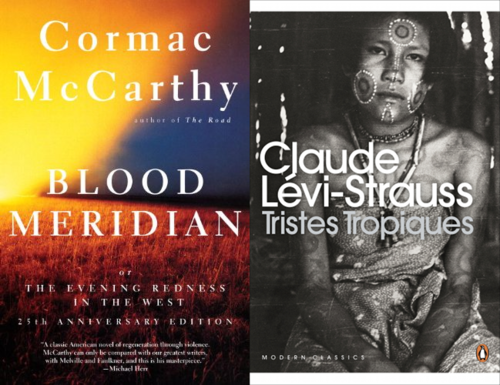
Let me start with two different ledes. First, I love Cormac McCarthy, but I’m a little embarrassed of that fact. Second, every writer really wants to be an anthropologist.
I mean, isn’t Cormac McCarthy a bit much, and aren’t we all a bit wary of the cowboy’s romance, awash in blood and ash as it were, a prevailing carelessness whose presidential poster child left us with a bitter taste in our mouths and confirmation that our capitalism is indeed late, that we are bivouacked here for the foreseeable future at the crumbling edge of our greed and haste? Isn’t the best thing a cowboy can do is fall in love and stay put, but don’t they mess it up every time? The thing about Blood Meridian is that it’s never a question why any of them are out there—call it fate, or call it, as the judge might, history—but the draw of the frontier is only a ploy for one’s own renunciations, for dismantling what has been received as the conditions of your life and conceiving of yourself, of the possibilities of humanity, in an altogether more fundamental—and thus truer—understanding. And isn’t this anthropology?
Read the whole piece at The Hairsplitter.
Against Content

Greenberg studies a Kenneth Noland
What is the proper way for an essay to begin? What if it’s short, without sources, and on a blog? What if it has a lede?
Clement Greenberg was an art critic and thinker working in the Unites States in the middle twentieth century, and I bring his name up because of the idea he helped foster known as medium specificity, which stresses the accountability of a work according to the characteristics of its given medium—for instance, that a painting should exhibit skills and awareness of the two-dimensional plane, of color, maybe, rectilinearity. Equally, in which case, a painting should not rely on the characteristics it shares with any or all other mediums—say, story. It is an idea that compels the rise, in painting, of Abstract Expressionism, abandoning representation of three-dimensional objects (people, streets, birds, flowers, etc) and, altogether, the three-dimensional plane, in favor of emphasis on flatness, line and color. A painting should not have a subject other than itself, one might say.
Greenberg described this notion as it was situated historically in his essay “Modernist Painting,”which I have taken from Art in Theory: 1900-2000, ed. Charles Harrison and Paul Wood:
“Realistic, illusionist art had dissembled the medium [of painting], using art to conceal art. Modernism used art to call attention to art. The limitations that constitute the medium of painting—the flat surface, the shape of the support, the properties of pigment—were treated by the Old Masters as negative factors that could be acknowledge only implicitly or indirectly. Modernist painting has come to regard these same limitations as positive factors that are to be acknowledged openly…
…The Old Masters had sensed that it was necessary to preserve what is called the integrity of the picture plane: that is, to signify the enduring presence of flatness under the most vivid illusion of three-dimensional space. The apparent contradiction involved—the dialectical tension, to use a fashionable but apt phrase—was essential to the success of their art, as it is indeed to the success of all pictorial art. The Modernists have neither avoided nor resolved this contradiction; rather, they have reversed its terms. One is made aware of the flatness of their pictures before, instead of after, being made aware of what the flatness contains. Whereas one tends to see what is in an Old Master before seeing it as a picture, one sees a Modernist painting as a picture first. This is, of course, the best way of seeing any kind of picture, Old Master or Modernist, but Modernism imposes it as the only and necessary way, and Modernism’s success in doing so is a success of self-criticism.”
The applications of this thinking to poetry are myriad and profound, ranging from a defense of the rejection of narrative to the experimental use of word placement on the page, but I wish to apply this idea to something a little broader and more ambiguous, which is our contemporary state of curatorship.
To be sure, I am speaking of the media deluge through which we swim and, more specifically, our behavior within that deluge. On an individual level, the media landscape can take many different forms, weighted toward densities of and emphasis on different types of media. For one person, the deluge is full of news. For another, funny videos. Another, recipes. And for most us it exists behind all of that in advertising, in a murmur of Helvetica and The Rule of Thirds, from which there tries to jump something that wants to ride your mind back into significance.
While these agents have arrested our attention for a long time, what is new is their sheer abundance, the technologies and motivations we have toward recording, collecting and delivering them. History is no longer something to remember but something to simulate. Or more importantly, it is something to organize.
The burden of this task is answered in the immediate by the concept of medium specificity. As I said, I believe this burden is new, and part of the excitement in the information age, in the industries that have sprung up within it, is the feeling that all the worlds treasures have just washed up on your own private shore. The first thing we must do is name its constituents and parts, and we do that by understanding kinds and the characteristics that define them. We put the rings in a box and hang the necklaces on a branch. If it were a painting, we would decide so because it is flat, rectangular, and with line and color. Our first act is a metaphysical one, a categorization. Our second is evaluation. We choose our finest of each.
We are surprised into these tasks, but even in this beginning stage come under threat. We do not know what characteristics are true definitions, and, I think we err. After awhile we begin to see, not forms, but themes, and the themes become seductive, in the end, the exclusive reason we choose to watch, read, listen to, or look at something.
Let me tell you something about me. I like giraffes. I think they are funny looking. I have several figurines in my house. I have a documentary. I have shopped for giraffe stuff. Such behavior, in moderation, is an amusement of the privileges we have. But it has an insidious force. When I am shopping for giraffe things, when I see them in shops, I do not see the real objects of the world. I see a giraffe. I am no longer capable of proper judgment.
There is a reason we have this inclination. The tension between theme and form is a tension precisely between the mind and the universe. The mind finds form too pixelated. There are simply too many forms in the universe, and it overwhelms our ability to assemble a plan. To help ease the data load, the mind creates themes, personal relevance, narrative. I like giraffes not because of their form, but because of there place as part of my identity—they are something I express about myself, and that is a theme. Perhaps the theme.
This is the environment into which the media deluge swims, and the media deluge is the inhabitant that most demands our ability to see its forms. That we wish to order things according to who we are, what we say we like, what we support as politics or ideology, even what we support as aesthetics, is natural and not without its virtue. But such themes make the qualities of a form less present to us, and we lose our rigor. We lose the capability of judging a piece of media, a message, by its quality, by the seriousness of its attempt, by its legitimacy within a field, its appropriateness. We stop seeing that it is a message at all.
The true danger of this oversight is that we relinquish control. We are set to amass in demographics, regions, in audiences and trends. We react softly to the deluge and let it shape us so long as it promises to show us who we are. Perhaps it will take us somewhere good. But we won’t know, because we won’t be able to see it.
Nick Demske’s Nick Demske
 Nick Demske by Nick Demske
My rating: 5 of 5 stars
Fantastic exploration of the profane, abject, and vulgar via forced sonnets that feel rather like a corpse being stuffed back into a live body. One of the best displays of the excising of language, based on language cliches, ephemera (advertising, phone messages, etc), and their frenetic reworking–language as excrement, the sloughed off. Not to mention a study of onanism, a more physical-feeling solipsism. Julia Kristeva eat your heart out. Paired finely with moments of startling imagery and sound: “Cup full of athlete, / Spilling. Huffing mouth-to-mouth at a carrion / Heap, petting these bunnies to pieces” (“Whether My Head Or This Wall Will Be first To Surrender”)
On the negative slope, either the poet or the reader gets a little well baked in this. Not sure the commitment to the form and mood and even the theory sustains the entirety of the collection. Or maybe I’m just TV-A.D.D., but I found myself getting eager to finish as I approached the end. Subtle issue–collection is still worth every penny you pay.
Hung in the Air
I was hoping to do a post about some recent conversations I’ve had about the curatorial work our contemporary condition requires of us, and I hope to do that, perhaps next, but this other issue has been frequenting my lunches with Jay, and I feel closest to them now and would like to share a few of their inquiries.
I want to talk about time. It’s a complicated subject, no doubt. It’s complicated specifically with a number of entryways, but I want to cut through as much of this as I can and get down to this: we are all going to die. I don’t mean each of us, individually, in scattered hospitals or nursing homes at whatever our “chosen”…”time,” but rather, that we are all going to die collectively–humankind, is going to die, perhaps all life on planet earth, is going to cease existing, and there is an increasingly solid agreement that this is going to happen sooner rather than later.
To me, and to many, the likely cause of this death will be environmental destruction. But in the past, especially, ten years, a very clear and present ( 🙂 ) paradigm has shifted. Let me list quickly for you a number of items that have occupied recent thought:
1. Increasing awareness of our extremely complex and absolutely devastating practices against our planet and its ecologies. This has just been posited.
2. A severe economic crises that threatened (threatens) the entire mechanism that moves our people and resources around and within one another.
3. Similarly, a move of the centers of production as far to the other side of the world as possible. The fallout, good and bad and otherwise.
4. A holy/culture war. Several fronts. Foreign and domestic.
5. An explosion in information and computing technologies such as to create an “information age” or a “knowledge economy.” Subsequently, an intense media saturation, an overturn of entire communications behaviors and institutions, and lastly a satisfaction we have, perhaps, never known, at least in terms of abundance.
These are all well known concerns, and not all are bad. But the question I am very tempted to ask is if the combination/proximity of these concerns are, not, without, but with very little, precedence. I think most would say yes and agree that there is a sizable angle of change pulling beneath us.
I don’t mean to be getting incapacitatingly freaked-out, but rather to steer these emotions toward a subject we all might profit from understanding better, which is how the sense of change and the risk of its failure disrupt our sense of time.
Let me tell you a “when my Grandfather died” story, which goes like this:
When my grandfather died, I had a hidden joy. Not for his death, his death terrified me–rather, for the disruption it caused. I was out of school for about a week. Every boy loves to be out of school, but there was more to this. I was out to be among people and to talk and think. I thought of my Grandfather’s life. I thought of his death. I thought of my parents’ death, and of my own. And packed around this in sheaths were the wet days of that week. All the ceremony, the family, the eating and stories pulled fine threads through the week and held it there as though up, briefly, to be observed. In this suspension, action is impossible. Of course, there is much to be done with a funeral, which is something I do not understand because I have, thankfully, never had to manage one. But everything else that tugged me forward with the promise of letting me touch it sat idle, in an eddy, limning the gate through which I eventually returned to my life from that interim. Every death I have been near has caused this reaction, but more so, every significant change. Surrounding it are these days.
But I feel we are now perpetually in this state, even as we push forward and design and build and trade. Perhaps it is even the exact opposite, that the present feels to us unloosened and gliding the convection of our activities. Because of our prolonged cues. It is the environment in which we live. Perhaps I speak mostly for myself, but it is a sense I have felt from my peers as well, and the best I can describe it is as a kind of despondence, an acceptance of a much more limited set of ambitions. I do not need to speak about the dangers of this kind of state of mind, but I do feel it necessary to say how unfortunate it would be that we cannot use all the good we have made, not only to rescue ourselves but to realize something better, simply because of our lack of will.
D.A. Powell’s Chronic
Popping in after awhile for a short review:

My rating: 3 of 5 stars
I really wanted to like this, and I did at first. His talent is irrefutable, and when I felt him in more designy shoes, as in the more formalist poems in the opening pages, I connected more. But once he started engaging his subject matter, mostly, environmental and health devastation, I found the poems to move much less certainly, much too conscious of and forcing themselves toward the larger thematic concerns of the collection. Perhaps I’m biased against strong subjects in collections, but I’d almost rather read an essay than poems on these topics.
Something’s Touching My Leg. It’s My Other Leg.
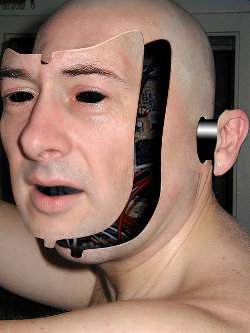
So I have been working out this poem, which is part of a series of lyrics, where the speaker’s central concern is a desire to become a monster. It’s slightly off territory for me, not so much that it is macabre or sci-fi or anything like that, but that the speaker must, in order to want monstrosity, be a lovely fellow indeed. He is a public speaker (something I do, oddly, write a lot about, though I am not much of one myself) and it’s pretty much gold and wind pouring out of his mouth all the time. I suppose some of this is beside the point, but my question for you is, do you ever feel any kind of desire like this, to be a monster? Try and think for a minute beyond childhood fantasy or the slightly more adult desire to have, say, special powers, some kind of hybrid prowess, like a cheetah’s speed or a bird’s ability to fly, or, as evidenced by this rather creepy picture , mechanical (hydraulic) strength and computation, and try to think of some moment where you have more desired to be so fully off the grid that the very nature of your body is in question.
To me, this is true monstrosity, a discomfort with oneself, a feeling of a foreigner controlling parts of you. This doesn’t really sound all that pleasant, really, ever, and as I was working this poem out I was asking myself a lot about the legitimacy of the speaker’s want. A lot of it is wrapped up in this want for ruin, to break out of the palace, and in some instances of this in mythology a kind of monstrousness gets evoked by the hero (the Buddha was a prince, and you could say his enlightenment was the introduction of some foreign element, something that made him less human, which, of course, is up for debate). But I still don’t think a desire for ruin, for change, necessarily lead to this idea of the monster. What does, however, is drama, and let me caveat that I am about to define the monster in an extremely loose way. Loneliness, isolation, ill-feelings, etc., are all marked by a kind of imbalance, in whatever form, and here there is a strong correlation to the monster, whose oversized or multiple arms or incredible strength or infrared vision or whatever else throw him straight through and beyond the standard deviations (digression: what I find so compelling about a character like Frankenstein is this attempt at becoming human, and that what keeps him from being so is not so much one given thing but a serious of very subtle errors or constraints that accumulate into one egregious whole. Frankenstein is really just a bit tall, square, and dumb, but that is enough to keep him from being human), and perhaps when we feel “out of sorts” ourselves it is precisely this sort of feeling that we are having, this being acutely marginalized, this being so beyond the reality we see around us that we can’t possibly be a natural inhabitant. So we feel monster sympathy, Frankenstein is lovable, as is WALL-E, as is Spock (okay maybe not lovable). We sympathize because they are outsiders, by their very nature, and we have flirted with that sort of permanent banishment, at least in the way we feel we are treated. I guess there’s also this whole uncanny valley thing, but damn it that’s for another time–what I really came here to show you was one of my favorite Lorca poems. Pick him up anywhere, really (feeling link lazy), though this translation is W.S. Merwin (I guess you should now the poem is by Lorca of the Federico García variety). I think the relevance to all this monster banter will be apparent.
()
Cancion del Naranjo Seco
Leñador.
Córtame la sombra.
Líbrame del suplicio
de verme sin toronjas.
¿Por qué nací entre espejos?
El día me da vueltas,
y la noche me copia
en todas sus estrellas.
Quiero vivir-sin verme.
Y hormigas y vilanos
soñaré que son mis
hojas y mis pájaros.
Leñador.
Córtame la sombra.
Líbrame del suplicio
de verme sin toronjas.
()
Song of the Barren Orange Tree
Woodcutter.
Cut my shadow from me.
Free me from the torment
of seeing myself without fruit.
Why was I born among mirrors?
The day walks in circles around me,
and the night copies me
in all it stars.
I want to live without seeing myself.
And I will dream that ants
and thistleburrs are my
leaves and my birds.
Woodcutter.
Cut my shadow from me.
Free me from the torment
of seeing myself without fruit.
The View of the Park through Two Offices
Hello hello! I know–totally cliche, this absence. But listen, promises are like water; and many things have been happening out there among the parked cars and trees and things. I hope this still finds you, in whatever place you are.
Let me tell you, I got married. Twas lovely and deep and long, and I’ve been travelling and generally on a hiatus, but let me cut right to it: I’ve also been watching a lot of BBC Life and Planet Earth, and the long affairs I’ve had in their various wildernesses brings me to our engagement. Here is a clip from Planet Earth, an immense landscape and drama.
My question: Planet Earth and BBC Life bring vast audiences amazingly remote and unique phenomenon in stunning (as the parlance goes) hi-definition, technologically advanced media. Unlike some of Attenborough’s other nature programs, Planet Earth and BBC Life are in fact relatively thin on really detailed information about biology and ecology, opting instead for what feel like constant introductions to some of the most unique and artful and dramatic events and individuals on the planet. I think this is a very intelligent approach, and I think this because I think it is savvy and fits exactly today’s audiences’ needs. I know much of this is another conversation about the difficulties of something like Infinite Jest, where the hi-def and the dazzling in mass media are narcotic inhibitors of some other, more wildly enriched, deep and clear and true existence (stunning indeed). But where most, in my mind, manifestations of this trope provide no real other alternative than something, at best, imagined, or more often relegated to a small sect of either enlightened or simply unwilling individuals and their microsociety (think of any dystopian sci-fi), BBC’s groundbreaking programs not only provide an absolutely real alternative, well, they are completely about them. Now the content here varies. One can certainly say, if having watched any of the features on the birds of paradise in Papua New Guinea, that the subject perfectly folds into the medium’s “dazzling” qualities. And maybe this is why such features, specifically, are the most widely known–because the subject of them is so well married to the medium. But when I watch that wolf hunt, I feel something different, that immense landscape, the cold and the wind and the absolute shortness of time–and that is its own kind of reassurance to me. I envy that landscape for its simplicity, its blunt rules, even as I feel them most deeply because of the abundance of the world I live in and the access it provides. It’s a feeling that I recognize, that comes to me in books, but more so, anytime, basically, I am alone and out of doors. And above that, all of this, content and desire, tastes and opinions and associations and the wonder of it all and having to make one’s way through. So I hold these nature programs as one of those things, as a unit in my cultural currency, even as I am conscious that my literateness and sophistication bely a world that has little difference from the animals I watch, in both’s subjection to vicissitudes, the take and have taken. So I am left with a peculiar sense–that I am glad for the candy and glad for the lesson as well, but also, that I am hopelessly lost, that both must always come paired. It’s a question of authenticity as it exists as a noun, free of that which it describes. I suppose.
Or perhaps the real irony is that, if you are conscious of the high technical quality of these programs, you are also conscious that such advances mark a very particular point in time, ours, now, when no doubt nature is in peril. This could be, in essence, a funeral. I don’t think we want to think this, and I’ll leave it at that–as the great problem not by BBC’s programs, but certainly brought forth through them. In the end, I think we are better for watching such testaments, that they might, indeed, live within us, be something that amazes us still.
The Impossibility of Irony in “Lost”
Alright, let’s talk about Lost. Like you, friend, I’m in the shit deep, and while I’ve hitherto forgone any mention of this television show here at P&O, I’ve good reason these days and wanted to engage you with a few brief questions. This largely comes on the heels of David Foster Wallace’s very excellent essay, “E Unibus Pluram: Television and U.S. Fiction,” published in A Supposedly Fun Thing I’ll Never Do Again. Buy it, seriously. Much like Lost, this is essay is far too expansive to do any justice to in a single blog post, but I want to zero in one of its main arguments and use this view as a way of looking at Lost as, perhaps, an important historical change in television and television culture. Or at least, I’ll try to tickle this idea.
And it goes as such: television is inherently ironic. Wallace does much to explain the technical medium of television and how it leads to irony, and he cites several early and contemporary examples of profuse irony within television’s content itself, not to mention its effects, raison d’etre, and basically anything else one would want to know, but I will save all of that for tomorrow when you read his essay. Also, this essay was written almost twenty years ago, and given how forward-looking Wallace is, one does well to pick up on his “forecasts” and see how television now has become even more ironic. Granted, I don’t watch a lot of television—Lost is basically it—but I am a young U.S. citizen, born within television’s historical boundaries, and I feel I know it as intimately as the next person. I certainly have watched a lot of television. And what I see is an almost bombastic deployment of irony. There is the obvious irony in “reality television,” (American Idol somehow holds both number 1 and number 2 in Nielsen’s rankings), where YOU are both the star and the audience, but there is also the irony, quite differently rendered, in shows like The Office, which is essentially one long telling of the joke “no one really behaves like this, but wouldn’t it be great if someone did?” Both shows are way complicated, and I’m really just using them as reductive examples of basically million horsepower irony transmissions (a clean double entendre for you there).
These are obvious places where irony works, but I think people (and by this, I mean the people I talk to, which is granted not a representative slice of America) tend to watch ALL television in a kind of ironic way. The other example of this sees equal counterparts in pop films, as well, but in TV it surfaces in shows like House or 24, which are also complicated and have their own, perhaps, ironic humors written into their code, but which are ultimately sincere. More importantly, hyperbolic. Just think of the deafeningly loud clock ticks that are the hallmark of 24—it’s maybe one of the most over-the-top sales pitches for suspense I’ve ever encountered. And the general feeling I have is that people enjoy hyperbole because 1.) it isn’t really asking them to believe it, and 2.) it’s exciting to watch how ridiculous the hyperbole can get, how much technology can be deployed.
And Lost pretty obviously falls in this latter category, except it does hyperbole so well, with such commitment, that it makes any show not about deserted islands, smoke monsters, quantum mechanics, time travel, ghosts, submarines, multinational corporate conspiracies, human fertility, utopian science cults, assassins, torturers, drunks, spinal surgeons, con men, fugitives, heroin addicts, codes and lies and black stones and white stones and planes-ripped-in-half-mid-air seem about as serious as Teletubbies. However, where I can watch a show like 24 ironically, and be somewhat amused, if hate myself a little, it is absolutely impossible to do with Lost. I mean, I know they are kidding around, they must be, no one can take this shit seriously (not even the producers and writers, if you watch their somewhat irreverent features), and yet, for some reason, I am compelled to believe. And by that, I don’t mean believe the show literally, but rather, believe that the show, through its bombast, is trying to touch something deep and core and human in me that is like the single golden eye hook through which time and history and all of humanity slides at the very center of my being—that the show is trying to connect me. Now let’s be very clear: I am not saying that the show is successful at this, at inducing some kind of religious (vis. religion, from re-ligio, linking back) experience in me. In fact, enough about the show prevents it: mostly, by being mediocre: that the characters and their situations in no way exhibit anything like verite, that the dialogue is so awful I feel embarrassed even tolerating it. Rather, what’s important here is that the pursuit for “religious” experience, for connecting viewers to a deep, cosmic order, feels genuine, so that an ironic viewing of Lost, and this is where it is unique, seems profane. The hyperbole must be dealt with as an earnest assessment of the way things are, and frankly I think our culture is a bit surprised by this.
Now, I’m not certain this surprise, pleasant or otherwise, is the reason so many of us continue to watch. Wouldn’t that make us conservatives, socially at least? Rather, I think there is a primary, if somewhat convoluted, reason Lost maintains its arrest on our attention: reference. I see reference in Lost as working in two primary ways: within and without itself. That Lost references everything from King Lear to Watership Down to A Brief History of Time, that its characters listen to Petula Clark and the Pixies, is no secret. But Lost spends equal effort referencing itself, and the subsequent games of recognition and the geometries of parallelisms viewers engage is one of the most entertaining aspects of the show, and the show knows it, so as the seasons have progressed the self-referencing has become more and more ostentatious. Now, both methods of reference are something contemporary viewers can understand deeply, especially as both methods are placed side by side, or, perhaps, even within each other. I mentioned in an earlier post an argument along these lines, that we have unprecedented technologies by which to access the world and history outside of us (internet) and unprecedented technologies by which to access the world and history inside of us (basically, psychology, but also physical technologies, like cameras with essentially infinite memories and networks where we can not only exhibit ourselves, but archive them, this blog, case in point), and that, basically, the boundaries between our interior selves and the exterior world have become a little slippery under the burden of information. And Lost enacts this notion exactly, so the real, true recognition of ourselves in the show is not in the characters but in the show’s mechanics—it’s M.O. is the same as ours.
And let me argue that we are very near, in fact, a very deep irony in Lost. Let me argue that the question viewers are asking about the end is not exactly how the show will end, what “side” will prevail, but rather, what is the ultimate reference? To what do we ultimately owe our experience? In a more naïve sense, this is a question about the first cause of the island, but as I am positing it, this question extends out beyond the limits of its plot and the universe of the script. It is a question about ourselves, what “version” of us is the true one, just as, what “version” of the island is true? And the irony is that, simultaneously, all versions and no versions are the true one. The reference will always be a reference to a reference, and the meaning we garner will be a performative one, an acquaintance with such regress where no first cause exists. Or something like that. Apologies to Baudrillard.
 Plots and Oaths