Bent Beneath the Low Heavens: An Interview with Dan Rosenberg

DanRosenbergDan Rosenberg is a deeply curious poet, experimental, playful, always pushing after new forms and approaches. It’s evident in the books he has published, each of which expresses new talents, from the image-and-voice-driven pieces of The Crushing Organto the tight and angular poems of cadabra to the exuberant sublimity of his latest chapbook, Thigh’s Hollow, which has just come out from Omnidawn. His successes with reinvention give any poet exhausted with “finding one’s voice” a refreshing new outlook: the voice is always right in front of you, part of whatever project you are pursuing.

He is a generous poet and a great conversationalist, and we had a chance for a quick couple of exchanges that got right to it, ranging from Eliot to Wittgenstein, from Nintendo to the Song of Solomon.

Read the interview at Michigan Quarterly Review.

A Field Guide to the Yi-Fen Chou Case and Identity Politics in the Arts

CONT BIO image

I don’t know if you’ve heard, but there’s this guy running around claiming to be Chinese, and he happens to write poetry, and, right, he’s not Chinese. Also, it worked. This guy, Michael Derrick Hudson, writing under the pseudonym Yi-Fen Chou, now has himself a Best American Poetry badge. He’s an imposter, a charlatan, appropriating ethnicity as a tactic for getting an accolade, or maybe as an activist performance to highlight the injustices of reverse racism. A lot of people have been talking about it, passionately, personally, with anger and frustration, laying out an arsenal of theories and logics to establish or reinforce what we might call the proper ethics of artistic identity, of identity politics and the right to voice.

At this late hour in the news cycle of the Yi-Fen Chou debacle there has been enough conversation to offer a fairly coherent set of coordinates that map the proprieties of ethnic and racial identity in contemporary American poetry, in the immediate, and in American culture more broadly construed. If you want the news, you can read what Jennifer Schuessler has to report at the New York Times. If you want to hear it straight from the editor—Sherman Alexie—who has been wringing his hands over the affair, you can read his extraordinarily thoughtful response at the BAP blog. If you want a roundup of the conversation, the Poetry Foundation has it for you.

What follows here is a rough and succinct guide to the central issues that constitute this story, the ways we think about who we are and whether we can pretend to be someone else. A nota bene—you will no doubt notice my name as an Asian one. I have many personal feelings on this matter, but for the most part my aim is simply to break down the dialogue into the most meaningful and illuminating categories that I can.

So let’s get on with it. . . .

Read the guide at Michigan Quarterly Review

Tomaž Šalamun: A Love List of Lines

download-620x397

Since Tomaž Šalamun’s death at the end of last year, I have been living with his poetry, walking around with it, running my hands back and forth across its lines, coming to find in its voice a friend, even though I never took a class with him, never spoke a word to him, and hardly even know about his life.

He is the kind of poet who has this effect. Many tributes were erected when he passed. . . .

I cannot offer here what others already have, but I can follow in Merrill’s footsteps and say that for a poet of such breadth, of such aggressive exploration, experimentation, absurdism—for a poet who will always surprise, and often haunt with dark themes—he is also one who leaves me feeling deeply welcomed. His intellect is warmed through with spirit and good will, a sense that kindness is the most important of all, because it can endure.

Šalamun leaves us the most incredible gift—many collections yet to be translated into English. I look forward to the first of these, Justice, due in October from Black Ocean.

In the meantime, I want to offer, as humbly as I can, this love list of lines, moments (all drawn from The Four Questions of Melancholy, which spans his work from 1966–1995) that have been with me these past nine months. . .

Read the feature at Michigan Quarterly Review

What is Inside?: An Interview with Carrie Olivia Adams

OTCOA


Carrie Olivia Adams is a poet as much of the line as what’s in-between them, and her newest book, Operating Theater, is no exception. A haunting drama of the liminality of the body, this dialogue-driven play-poem asks over and over one profound question:what is inside? Steeped in Victorian surgical manuals and medical X-rays, the voices here explore the tension between the mind and the body, between subject and other, asking how we can know, and from knowing, live together, in a house, or in a city.

I had a chance to ask Carrie a few questions about this book (and film her reading from a brief section). . .

Read the interview at Michigan Quarterly Review

Book Review, “Poems (1962–1997),” by Robert Lax

robert-lax-620x430

These poems certainly elicit skepticism, but they are more than simple conceptual or design exercises. They have an oddly effective way of opening up. This is the sort of art you think you could easily make, but when you sit down to it, you make something of horribly poorer quality. Artful elimination requires a deeply tuned dedication, a kind of mental conditioning. This is how John Beer—former assistant to Lax and editor of this collection—roughly describes it in his wonderful introduction: during the writing of these poems, Lax led a spare, if not ascetic life on the Greek islands, handwriting notebooks worth of work—several poems a day—from which he would later select and typeset only the very best “worthy of preservation.”

Read the review at Michigan Quarterly Review

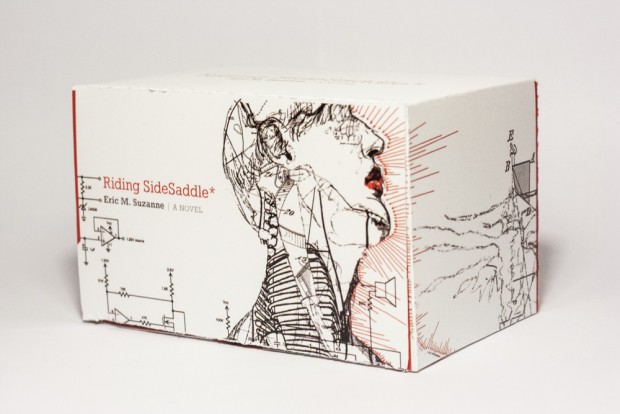
On Riding SideSaddle*: An Interview with Eric Suzanne

Riding-SideSaddle-620x414

Riding SideSaddle* is not like most things you’ve read. On the surface it startles with its three-dimensionality—it’s not a spinebound book but a deck of cards, and you shuffle it before each reading. It’s a new, and wonderful, adventure each time, a story of outcasts, their caretaker, and the friendship and love they find with each other. It’s a story about the body and hybridity—based on the myth of Hermaphroditus—and it’s a story about magic and the slipperiness of categories.

Available in physical format from Springgun Press, it’s also available for free online at OddBooks, a reading platform written specifically around the novel and its randomizability. It’s also open-source—free to use, adapt, remix, and incorporate into other pieces. I talked with Eric Suzanne, the polymath visionary behind this project, about innovations with literary form as well as some of the issues—body, gender, friendship, memory—at work in the novel.

Read the entire interview at Michigan Quarterly Review.